U.S. Navy Deploys Seahawk Unmanned Vessel with Carrier Strike Group 9
The U.S. Navy has deployed the Seahawk, an unmanned surface vessel powered by Leidos Autonomous Vessel Architecture (LAVA), alongside the USS Theodore Roosevelt and Carrier Strike Group 9 for the first time in history. This sustained deployment moves beyond controlled trials to test real-world autonomous decision-making, sensor integration, and operational reliability within a combat formation.
By The Shipping Chronicle · AI-assisted reporting and explanations
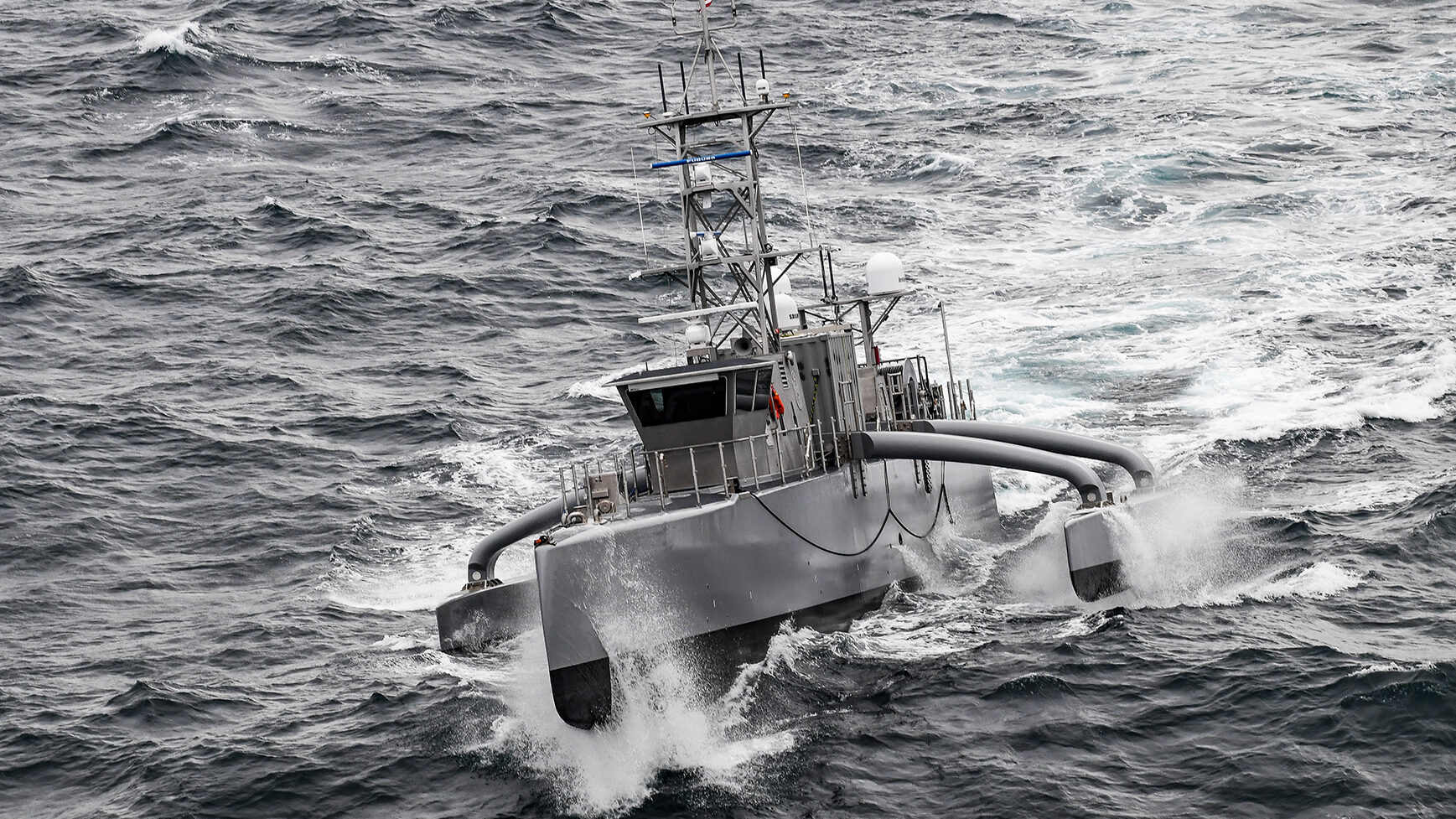
For the first time in U.S. naval history, an unmanned surface vessel has been deployed with a carrier strike group for a sustained operation. The Seahawk is sailing alongside the Nimitz-class aircraft carrier USS Theodore Roosevelt across the Pacific Ocean as part of Carrier Strike Group 9. This marks a significant shift from controlled testing environments to live operational integration, aiming to gather data on how autonomous systems interact with crewed warships during active missions.
The carrier group formation includes substantial assets beyond the aircraft carrier. Supporting vessels include the Ticonderoga-class cruiser USS Chosin, destroyers USS Paul Hamilton, USS Carl M. Levin, and USS Decatur. The air wing consists of Air Carrier Wing 11, featuring F-35C Lightning II fighters, EA-18G Growler electronic-attack aircraft, Super Hornets, and E-2D Hawkeye airborne early warning aircraft. Into this complex mix of manned platforms, the Seahawk operates as an autonomous surface component, coordinating with the group throughout the operation without onboard personnel.
The Seahawk utilizes Leidos Autonomous Vessel Architecture (LAVA) to manage navigation, obstacle avoidance, and mission completion. LAVA serves as the software and hardware framework enabling the vessel to interpret changing operational requirements and make decisions independently. While the Seahawk does not carry extra ammunition for the strike group, its role is to extend the fleet’s sensing, monitoring, and surveillance capabilities. It is designed to carry additional payloads, including sensor systems, weapons, and electronic warfare equipment, potentially adding depth to the group's defensive and offensive posture without duplicating the roles of existing ships.
A primary objective of this deployment is testing the reliability and efficiency of an autonomous vessel under real-world conditions. Previous trials have largely occurred in controlled settings; this long-duration deployment allows the Navy to evaluate how the Seahawk interacts with escorts, replenishment ships, and destroyers over time. Such extended operations are necessary to ascertain maintenance needs, endurance limits, and the practicalities of autonomous decision-making in a dynamic maritime environment.
This experiment aims to generate valuable data that controlled trials cannot provide, highlighting areas for improvement in system design and integration. The Navy seeks to understand how unmanned autonomous vessels can complement crewed vessels effectively. The focus remains on enhancing existing capabilities rather than expanding the workforce. By integrating these unmanned assets, the service hopes to widen its situational awareness and operational flexibility while avoiding the need to recruit additional naval personnel for expanded duties.
The outcome of this deployment will help determine future integration strategies for autonomous ships in naval formations. Success could lead to broader adoption of unmanned systems for tasks such as persistent surveillance, electronic warfare support, or acting as forward sensors for the strike group. Conversely, identified limitations will inform refinements to LAVA and other autonomous architectures before larger-scale implementation.